Home of the Most Underemployed
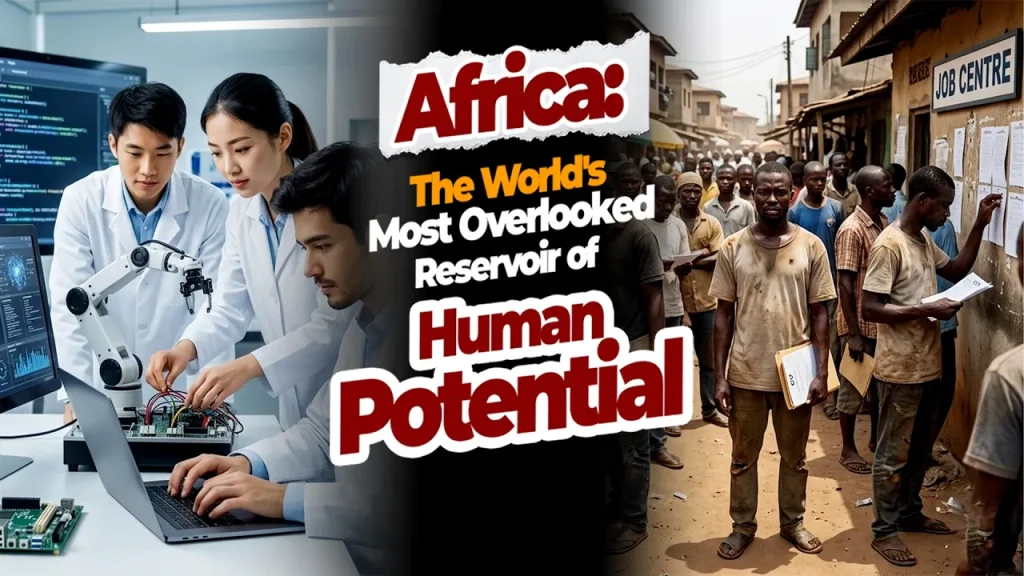
No continent has more jobless, hopeless, and uneducated young people than Africa. In Nigeria, which has a population of 237 million, less than 4% are over 65. You can drive throughout the country and struggle to see elderly people. Over 70 million Nigerians are under 15, while 140 million are under 30. Most of these 140 million young people are jobless, lack hope, and do not have skills comparable to those of an average Westerner or East Asian.
The Democratic Republic of the Congo has 113 million people, with 55 million under 15, and 70% of the population under 25, totalling over 80 million young people. West Africa, with a population of 470 million, has 40% of its population under 15, totalling 188 million—a figure greater than the total number of under-15s in Europe, which stands at 104 million. When I say Europe, I mean the continent of Europe, not just the EU. This includes the UK, Russia, Ukraine, and every European country, encompassing 744 million people. Remarkably, West Africa alone has more young people than the entire North American region.
In West Africa, a staggering 310 million people are under 25, making it the youngest region in the world. This represents the highest proportion of young people ever recorded in a specific area in human history. Now, considering black Africa as a whole, it has a population of 1.3 billion, with 40% under 15, totalling 520 million—more than the combined populations of the EU or the US and Canada. When we extend this to include those under 30, the number rises to 900 million young people, accounting for 70% of black Africa’s population. Some countries have average ages as low as 16, 17, or 18, which are about half those in Japan, Korea, and Europe, and just about half those in the US and Canada.
Now that we have set the scene, let’s look at what these young people do.
Many young people in Africa lack stable jobs and do not possess skills comparable to those of their peers in Western and East Asian countries. Africa is experiencing the world’s largest waste of human capital, primarily due to leaders whose perspectives are rooted in 1960s and 1970s ideologies. Although fewer than 4% of Nigerians are over 65, over 80% of the leadership is in this age group. Nigeria faces this issue alongside many other African countries; from Cameroon to Côte d’Ivoire, Angola to Congo-Brazzaville, and Uganda to Togo, many African presidents fail to represent the reality of the continent’s younger population. Of the 900 million people under 30 in Africa, fewer than 10% are educated or possess skills comparable to those of the average American, Japanese, Korean, Chinese, British, German, or Norwegian.
This is why I refer to this situation as the greatest waste of human capital in history. When young people lack jobs or the opportunity for decent careers, they tend to loiter and feel aimless. Idleness breeds negativity, and when these young people see their peers in North America, Europe, and East Asia thriving through social media, it’s natural for them to feel discontented. Many attempt to migrate to Europe and North America in search of better opportunities.
While India may face poverty and overpopulation, it is not lacking in highly skilled human capital. Unfortunately, African leadership has not established an environment in which this invaluable asset—human capital—can be developed into a new generation of innovators, engineers, and other talented people. This failure prevents the continent from transforming from a net recipient of aid to a net exporter of remarkable talent and expertise.
Doctors, engineers, and other professionals trained in Africa are often less well educated than those trained in the West and East Asia. Personally, I wouldn’t feel comfortable allowing a Nigerian-trained doctor to operate on me. Similarly, I wouldn’t trust a Nigerian mechanic to work on my car engine, nor would I board an aircraft if I knew the pilot was trained in Nigeria. Regardless of whether they are from East, West, Central, or even Southern Africa—Black Africa’s most stable and advanced region—I would still proceed with caution when considering professionals from the continent.
Universities in West and Central Africa often fall short of the standards expected of higher education institutions. Nigerian leadership has invested more in new cars, aircraft, and personal perks than in education and healthcare. The leadership in Cameroon seems disconnected, living in Switzerland and unaware of the pressing issues back home. In countries such as Congo-Brazzaville, the Democratic Republic of the Congo, Côte d’Ivoire, Angola, Uganda, and Tanzania, priority is often given to securing lavish lifestyles for those in power rather than providing adequate education and living conditions for youth.
When young people find themselves without jobs and come from families that lack proper planning or parenting skills, they go around having endless sex and parties, with some of the most disgusting debauchery known to man. Africa is the global centre for sex. Some girls start having sex from as young as ten.
Restructuring a country to provide decent schools, infrastructure, and a functioning system that benefits everyone can take decades. As a result, their leadership has compromised the futures of many of Africa’s 520 million young people under the age of 15. Youth unemployment among those under 25 accounts for roughly 60% of total unemployment in sub-Saharan Africa.
Another concerning issue is employment exploitation. A significant number of people employed in the informal sector in sub-Saharan Africa are subject to exploitation, facing a lack of job security and workers’ rights. Many people are often made to work longer hours for less pay or pay that comes late. Currently, 74% of Africans work in the informal sector, and some do not receive any pay at all because weak regulatory systems exist. The laws, judiciary, police, and governmental institutions are inefficient and neglected.
Africa’s human capital potential is vastly underutilised, with millions of young people not engaged in education, employment, or training, representing a significant missed opportunity for economic growth. Despite having the world’s youngest population, with a median age of 19, the Human Capital Index (HCI) indicates that the region is only achieving 40% of its potential productivity.
The education and health systems in Africa are flawed, resulting in poorly educated and poorly equipped graduates. While they may possess theoretical knowledge, they often lack practical, applicable skills. Many skilled, well-educated Africans engage in subsistence activities rather than become the continent’s economic drivers. Women face even greater challenges, particularly with early marriage, which hinders their full participation in the labour force.
Currently, around 89% of 10-year-olds in Sub-Saharan Africa cannot read and comprehend a simple text. Additionally, approximately 27% of children under five are stunted, leading to long-term cognitive and physical limitations that significantly impact future productivity. Many African nations underinvest in critical areas such as health, nutrition, and education. In some cases, countries spend more on servicing debts incurred by their leadership and close associates. As AI and robotics continue to advance, skilled workers are becoming increasingly in demand, rather than manual labourers.
Why is Africa getting poorer? In 1990, the continent accounted for just 14% of the world’s population living in poverty; today, that figure has risen to 40% and is projected to reach 80% by 2030. Under the current system, there is little hope for Africa’s future. If I were to have a one-on-one conversation with various African presidents and ask them critical questions, I believe three-quarters of them would either have no clue or would never have bothered to think about these issues.
Imagine having people like Yoweri K. Museveni of Uganda, Paul Biya of Cameroon, Bola Tinubu of Nigeria, or Denis Sassou Nguesso of Congo-Brazzaville running countries. Where do you think they would lead the people to? Dead end, of course!
The West experienced an era of prosperity, during which it thrived and expanded its influence worldwide. Now, it appears that Asia is taking the lead. Some claim that the next century will belong to Africa, but this belief is far detached from reality. Africa has barely begun to tap into its potential. Its youth, which should be its greatest asset, cannot compete with the younger demographics of Taiwan, the Netherlands, South Korea, or Japan. As the Digital Revolution transforms the globe, many African nations have fallen behind. Like any other people, African youth have the capacity to learn and excel in various fields. Still, the prevailing culture and structure of African leadership have stifled the potential of its talented human resources.
Watch the video version on YouTube at: https://youtu.be/pEY38JB8bXc
By Ikechukwu ORJI