Africa’s Natural Resources Aren’t Unique
When people invoke Africa, a few things come to mind. Mineral resources, poverty, and wildlife (lions, elephants, etc.). However, Africa may not be as endowed as you might think. You see, a few factors make a country or region lucrative for investment and talent. These aren’t limited to the following:
- Political Stability and Security
- Strong Economic Fundamentals
- Legal and Regulatory Environment
- High-Quality Infrastructure
- Talent and Labour Quality
- Investment Incentives
- Strategic Location and Openness
- Quality of Life
For the record, Black Africa does not include any of the eight categories already mentioned. First, Africa isn’t being exploited in the context of human capital flight or brain drain. I don’t see Microsoft, Tesla, or Tencent going to Africa to secure top human brains. Why? Because Africa doesn’t have the brains, it is often overlooked. Second, Africa doesn’t have the purchasing power. Most Africans earn less than $10 per day, which is 10 to 25 per cent less than in Europe, North America, Australia, Japan, and South Korea, and several times less than the rest of the world. Third, it doesn’t have manufacturing capacity; it can’t be exploited like China, India, Vietnam, and other Asian countries, where Western companies outsourced manufacturing. Fourth, its mineral resources are not unique. Many other countries also have the same mineral resources as Africa.
Yes, Africa doesn’t dominate in mineral resources. What are the top ten most important mineral resources outside crude oil, gas, gold, and diamonds? Copper, Lithium, Cobalt, Nickel, Rare Earth Elements, Iron Ore, Aluminium, Graphite, Manganese, and Platinum Group Metals (PGMs).
Copper:
Chile, Peru, and the Democratic Republic of Congo (DRC), China, and the United States.
Lithium:
Australia, Chile, China, Zimbabwe, and Argentina.
Cobalt:
DR Congo (70%), Indonesia, Russia, Canada, and the Philippines.
Nickel:
Indonesia, Philippines, Russia, New Caledonia, and Australia.
Rare Earth Elements:
China, the United States, Myanmar, Australia, and Thailand.
Iron Ore:
Australia, Brazil, China, India, and Russia.
Aluminium:
China, India, Russia, Canada, and the UAE.
Graphite:
China, Madagascar, Mozambique, Brazil, and South Korea.
Manganese:
South Africa, Gabon, Australia, China, and Ghana.
Platinum Group Metals:
South Africa, Russia, Zimbabwe, Canada, and the US.
Now, let’s add crude oil and gas to the list. Venezuela, Saudi Arabia, Iran, Canada, and Iraq each have more crude oil reserves than the whole of Africa. With approximately 126 billion barrels in Africa’s reserves, Venezuela alone has 303 billion, Saudi Arabia 267 billion, Iran 208 billion, Canada 163 billion, and Iraq 145 billion. The infrastructure in these countries is far superior and more accessible to the world’s top buyers than Africa’s.
Regarding natural gas, Russia, Iran, and Qatar each have more reserves than the whole of Africa combined. Russia has 1.68 billion, Iran 1.18 billion, and Qatar 858 million. Africa’s largest reserve is Nigeria, at 186 million, followed by Algeria, at 159 million. However, I don’t consider North African Arabs in my talks about Africa. They are not Black Africa. Still, even if Algeria were included in the list, Russia, Iran, and Qatar would still each have more than the whole of Africa.
Gold-producing Countries:
China, Russia, Australia, Canada, the US, Ghana, Mexico, Indonesia, Peru, and Uzbekistan. There is just a single African country in the top ten. Africa together produces a sizeable amount of gold, but on average, Russia, Australia, and Ghana produce more. And gold isn’t a niche mineral resource. Everyone has it.
Diamonds:
Russia, Botswana, Canada, DR Congo, South Africa, Angola, Zimbabwe, Namibia, Lesotho, and Sierra Leone. Again, Russia produces more diamonds than any other country, followed by Botswana. Africa produces about 61 million carats, while Russia alone produces 37 million carats annually. As with gold, it isn’t unique to Africa. Yes, Africa has gold and diamonds, but so too do Russia, the US, Australia, and others.
Rainforest:
When you hear about ‘Africa’s rainforest’, it refers to only six countries: the Democratic Republic of the Congo (DRC), Gabon, the Republic of the Congo, Cameroon, the Central African Republic, and Equatorial Guinea. Only Brazil’s share of the Amazon is bigger than Africa’s rainforest. Africa’s topography is dominated by vast high plateaus, escarpments, highlands, the Great Rift Valley, expansive savannahs, deserts, narrow coastal plains, and the rainforests mentioned earlier. The rainforest has the least diversity.
The picture is beginning to clear out. Africa lacks the brainpower or talent, purchasing power, security, stability, transparency, infrastructure, and quality of life. The burden on Africa is too much for it to bear. But there is one area where Africa could exploit to become the world’s largest food producer and eradicate hunger forever. It has 874 million hectares of arable land, more than Europe and North America combined, and probably more than South America combined. Yet 65% of the land is still uncultivated, which is why the people are starving. Even the 35% cultivated, if properly done and scaled, would be enough to feed the continent three times over.
Since I could think, the timber of my birth country, somewhere in Central Africa, has been sold to Westerners – not exploited, but sold fairly and squarely. You’d see these massive trucks being transported to the seaport. Where has the revenue from these timbers been? The Black African leaders have syphoned them for their families and fleeting enjoyment while the masses suffer. Where are all the revenues from gold, diamonds, crude oil, gas, and countless other mineral resources? Africa’s mineral resources have been sold, not – I repeat, not – exploited. We were paid, but where has the money gone? Black Africans, if you want to blame someone, blame yourselves.
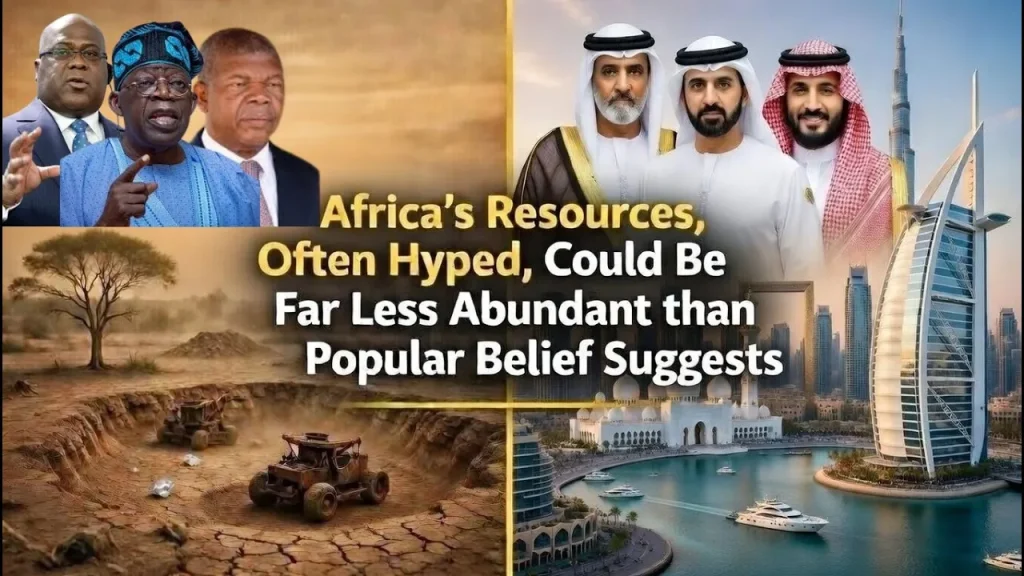
Nigeria has earned over $1 trillion in crude oil revenue since the 1970s. Between 2002 and 2013 alone, Angola received an estimated US$450 billion in oil income. Botswana, Gabon, Ghana, DR Congo, and many Black African countries have earned billions of dollars in revenue from mineral resources. Where did they invest those funds? We have seen how the Gulf countries have used their mineral resource revenues. Africa has only itself to blame, and no one else. The same people who bought our mineral resources also bought the Gulf countries’ mineral resources. We took ours to the nightclub, while the GCC countries invited the whites to build and manage their infrastructure and economies.
Watch the video version on YouTube at: https://youtu.be/1IgkEGWj9Iw
By Ikechukwu ORJI