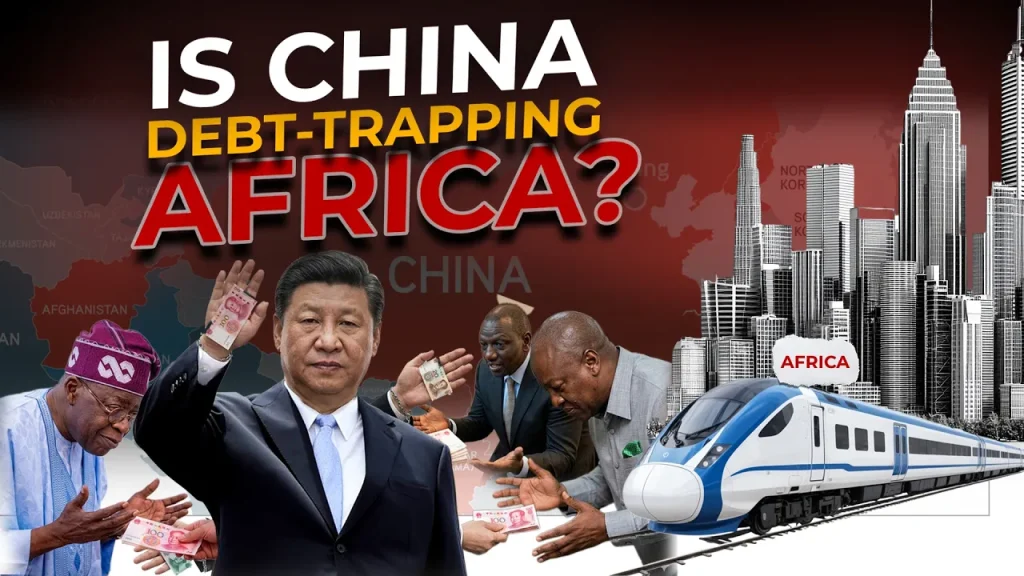
Is China Debt-Trapping Africa?
Dozens of African countries have loans from China. Some have borrowed more than they can chew. Angola’s debt to China is more than the combined debt of the next three top African countries. China has built cities, a train network, airports, and countless infrastructure projects in Angola, Nigeria, Kenya, Senegal, Ghana, Tanzania, and many other African countries.
In this video, we will review Chinese loans to Africa compared with those from the IMF and the World Bank. We will also look at what Chinese loans have done for Africa, compare China’s impact on the continent, and conclude whether there is such a thing as a China debt trap in Africa.
The top ten African countries’ total loan to the IMF is $89.1 billion, compared with $123 billion for China. Africa’s debt outlook has continued to deteriorate. All projections show a potential increase in debt-to-GDP ratios. These increases signify deteriorating near and long-term fiscal pressures, driven by underwhelming revenue performance. The Multilateral Debt Relief Initiative (MDRI) has helped 37+ countries, predominantly in Sub-Saharan Africa. South Africa (13.1%), Egypt (12.0%), and Nigeria (8.4%) alone account for over one-third of the continent’s external debt stock.
In 2005, Nigeria secured a landmark $18 billion debt relief deal with the Paris Club, cancelling approximately 60% of its $30 billion external debt. In 2006, Nigeria’s total debt was approximately $3.54 billion. Today, 20 years later, Nigeria’s debt has soared to $99.7 billion, driven by increased borrowing and the naira’s depreciation.
Since 2000, Chinese lenders have provided over $182 billion in loans to African countries, primarily focusing on infrastructure, energy, and transportation projects. These loans have played a crucial role in constructing essential infrastructure such as railways and power plants. However, they have also contributed to significant debt distress in several nations. Sifting through 24 African countries from 2000 to 2025, there is no doubt that Chinese loans significantly promote economic growth in Africa. Chinese loans indirectly contribute to economic growth by fostering increased investment.
The interest rates on IMF loans to African countries can reach 7%, depending on the type of loan. In contrast, World Bank loans typically have even lower interest rates. Chinese loans, on the other hand, generally have interest rates under 3%. There are instances in which some IMF loans have lower interest rates than Chinese loans. However, Chinese loans can be more effective because they are linked to infrastructure development projects carried out by the Chinese, making it more difficult for corrupt leaders in Africa to misappropriate funds.
Since 2000, Chinese companies have constructed or upgraded nearly 100,000 kilometres of road networks across Africa. They have also built over 10,000 kilometres of railway lines across the continent, introducing high-speed rail and metro systems in various countries. Additionally, modern airports have been established in Angola, Ethiopia, Mozambique, Nigeria, Zambia, and many other African nations. In just the last 25 years, China has significantly enhanced Africa’s infrastructure, surpassing what the continent has experienced over the previous 400 years on average—except in South Africa, where white South Africans developed infrastructure.
The United States remains the largest donor of aid to Africa and globally. Following the U.S. is the European Union, with Germany and France leading the way, and the United Kingdom also ranking in the top five, just ahead of Japan. Chinese aid to Africa comprises grants and loans for infrastructure development, totalling more than $180 billion since 2000. This is quite remarkable! Over the last twenty-five years, China has put more clothing and shoes on Africans and also appliances and electronic devices—such as air conditioning units, fans, phones, computers, buildings, bridges, motorways, trains, microwaves, refrigerators, mixers, washing machines, dishwashers, televisions, and countless other technologies—than the rest of the world has done in the past five hundred years.
The argument about a Chinese debt trap is unfounded. Several African countries, including Zambia, Ethiopia, and Ghana, have defaulted on their loans to China, yet none of their infrastructure has been seized, and no fines have been imposed. Instead, China has renegotiated loan conditions to reach mutually beneficial agreements. The rapid increase in Chinese loans can be attributed to their direct investment in infrastructure development. Chinese funding largely maintains the well-kept streets and buildings seen across Africa. African economies have become so reliant on China that they would struggle to function without it.
China is a major manufacturing economy that requires a market for its products. The West, on the other hand, has developed and now dominates the global soft economy, encompassing companies such as Visa, Mastercard, Google, Apple, and Microsoft. Although Taiwan is a leader in semiconductors, it relies on the Dutch company ASML, which holds a dominant position in photolithography systems necessary for semiconductor production.
However, Western economic influence does not extend to African economies, which are neither developed nor sufficiently lucrative. As a result, Chinese manufacturers see Africa as an ideal market for their goods, with minimal regulations. It is logical for China to extend loans that exceed the borrower’s repayment capacity. Many African countries welcome these loans, perceiving them as almost free money—until the time comes to repay them.
As we all know by now, Africans lack understanding of maintenance or long-term financial planning, so these loans are taken quickly without regard for future implications, leading to long-term debt burdens and high debt-to-GDP ratios. What Africa needs the most is infrastructure to power its economy, thus reducing poverty levels. The West no longer builds. If it has to be built, it will take longer and cost five times as much as in China. By the time the West debates whether to proceed with a project in their respective parliaments, China has already completed it at a fifth of the cost. This is why Africa is addicted to China.
Overall, is China a debt trap for African countries? Absolutely not. In the past three decades, China has been a significant force in reducing poverty in Africa. No other country has lifted more Africans out of poverty than China; in fact, China has done more to alleviate poverty on the continent than the entire West combined. Almost every structure built in Nigeria, Ghana, Senegal, Kenya, Tanzania, Angola, or Cameroon in the past twenty years owes its existence to China.
As soon as the Chinese aircraft industry booms, Africans will start living in one and working in another, thanks to China’s ability to mass-produce goods and keep prices low—something no other country can match. Africa needs China, just as China needs Africa. The relationship between China and Africa is more reciprocal compared to that with Western nations. Westerners just want Africans to stop coming to their countries and to take care of their own affairs, without burdening them. They’ve had enough of Africa, which is fair.
Watch the video version on YouTube at: https://youtu.be/I9p6LJPJyPs
By Ikechukwu ORJI