Why Do Black Women Often Wear Hair that Mimics the Features of Other Races?
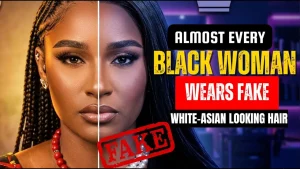
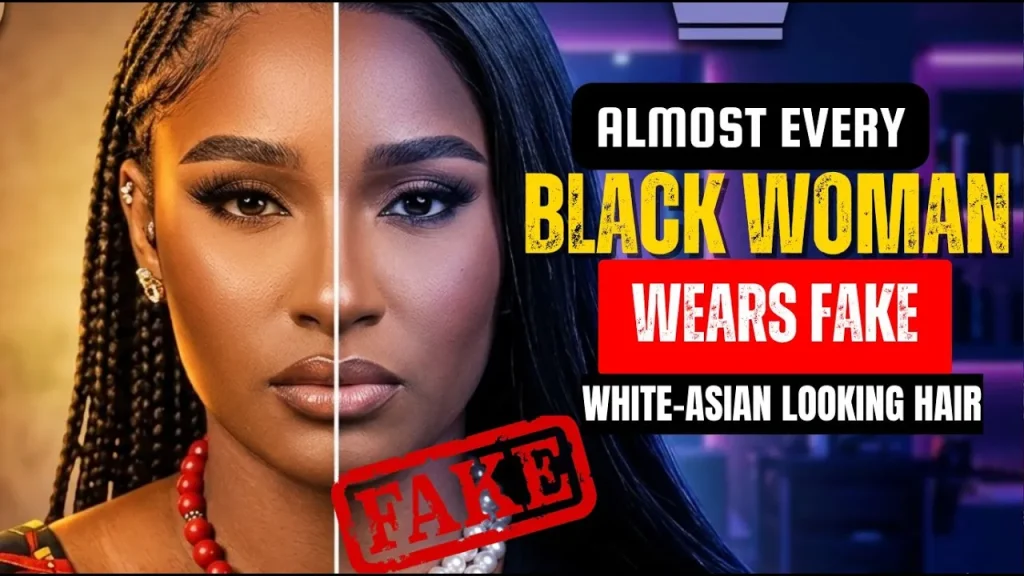
What is wrong with black hair texture? Why do black women hate their hair so much? They say black is beautiful, yet it’s striking that over 90% of Black women—whether in Africa, Brazil, Colombia, the USA, Canada, the UK, France, Germany, or elsewhere—have hair on their heads that is not natural to their race. They either wear fake wigs or natural white or Asian-looking hair obtained from humans of other races. What drives this choice?
In Nigeria, the poverty capital of the world, Nigerian women buy natural Asian hair, sometimes for up to $10,000. These are people who have nothing, but the natural white-and-Asian-looking hair industry has become more lucrative than industries such as waste management, sanitation, and research and development combined. The misplaced priority of the black African is never so glaring as the intensity black women put into their hair to look like white women. They have let white women set the beauty standards for them.
When I refer to black women or black people in general, I am not including individuals of mixed race. A person with one white (European), Japanese, Chinese, Korean, or Latino parent is not black. Are you listening to me, African Americans? Tiger Woods is not black. Barack Obama is not black. Naomi Osaka is not black. To Nigerians, William Troost-Ekong, Leon Balogun, Tyronne Ebuehi, and Ashleigh Plumptre are not black either. They are mixed-race people. They are black just as they are white. If biology is not taught in the African American education system, that is not my concern. Let’s move on, shall we?
Whether it is Michelle Obama, Naomi Campbell, Beyonce, Rihanna, Serena Williams, Tiwa Savage, Zozibini Tunzi, or Lupita Nyong’o, they all wear fake white or Asian-looking hair or wigs that are often styled to resemble white or Asian aesthetics. I must give credit to Lupita for sometimes embracing her natural, black hair.
In Africa, people not only wear hair that is influenced by white or Asian styles, but some also bleach their skin to achieve a lighter appearance.
You see, for all the white guys who are overweight and struggling to find hot girls, if you are into black women, consider flying to Nigeria, Ghana, Cameroon, Gabon, Côte d’Ivoire, or the various African countries and see how the women will run you over. In both Congos, even the men bleach their skin so terribly that some parts are dark, others light, and others a mixture of everything, which makes them look like African leopards. So, I ask, why are black people so obsessed with looking white?
The average black British, French, German, Dutch, and other Western black women spend about $3,000 on their fake white and Asian-looking hair. In Africa, that figure averages $600, even though about 40% of the population lives on less than $5 a day—often funded by many boyfriends willing to pay for it. What is it about black hair that leads black women to go to such lengths to conceal it?
From the south of the Sahel, extending west to the Gambia and then east to South Sudan, Kenya, Tanzania, Mozambique, and South Africa, and back north to Angola, the hair texture of our people is characterised by its density, thickness, and tight coils. Exceptions include Cushitic Africans, Berbers, Mbororo, and some groups in the northern Sahel and Nilotic regions, who have different hair textures, more akin to those found in the Middle East.
The dominance of Caucasians on our TV shows, films, and social media has significantly reshaped beauty standards. I mean, even Koreans, Japanese, Chinese, Indians, Filipinos, and many other Asians would whiten their skin; sometimes they appear so pale that I do not even see the point. Like the Asians, many black Africans struggle with an inferiority complex that prompts them to whiten their skin for reasons that I find difficult to comprehend.
However, when it comes to hair, there is a notable trend: around 90% of black women, regardless of their location, do not appear in public with their natural hair. This indicates a profound level of insecurity. However, one woman stands out in this context, and she makes no compromise. Ngozi Okonjo-Iweala, the Director-General of the WTO. She consistently showcases her heritage by wearing traditional Igbo outfits. Even during her 25-year tenure as managing director at the World Bank, she wore no fake white or Asian-looking hair.
In the 1960s and 1970s, our women in Africa, in particular, donned African outfits and proudly wore their natural hair in public. Is it sustainable for an entire race to be buying Indian, Brazilian, and other non-black human hair off poor humans so another race can wear them and pretend they are beautiful? How did we arrive here? What is this madness? Can you name even one black female celebrity, as I have defined—someone whose parents are both black, like me—who does not wear wigs or hair that resembles white or Asian styles?
Imagine an innocent Finnish, Russian, Korean, Chinese, or Japanese person who meets a black girl he fancies, and they start dating. One morning, when she had taken off the fake hair, he got the shock of his life, staring at his girlfriend like, ‘Who are you?’ While white, Asian, or Hispanic women often wear wigs as a fashion choice or for a short-term style, many black women seem to adopt fake white and Asian-looking wigs and human hair as a permanent shield against their natural hair. Hate me all you want, but this is madness! You can go ahead and unsubscribe from my channel. I refuse to play political correctness or create content merely to accommodate the sensitivities of any particular group.
Let’s look at black women around the world: Temi Otedola (Nigerian) wears fake hair. Genevieve Nnaji (Nigerian) wears fake hair. Mihlali Ndamase (South African) wears fake hair; Kelly Rowland (American) wears fake hair; Diane Abbott (British) wears fake hair; Denise Lewis (British) wears fake hair; Winnie Harlow (Canadian) wears fake hair; Sha’Carri Richardson (American) wears fake hair; Fátima Diame (Spanish) wears fake hair; Christine Ohuruogu (British) wears fake hair; and most of them all wear fake white and Asian-looking hair. Black women spend more time putting on or maintaining their fake Asian-looking hair than is necessary. You don’t need to wear them, black women. You are beautiful just the way you are.
When I was growing up, there was a saying: “Black is beautiful.” I’ve always wondered why we use that phrase specifically. Shouldn’t all humans be considered beautiful? When people see a puppy or a baby, they often say, “Oh, it, she, or he is beautiful.” This makes me question: are we implying that some puppies or babies are ugly?
What I’m trying to convey is that Hollywood and white standards should not define beauty. The absence of a strong black presence that has successfully created a developed nation, culture, and identity has left the global black community fragmented among the dominant cultures that shape their world. As a result, black women often feel pressured to conform to beauty standards established by others. The failure of the black race goes far beyond the dirty streets of Africa. It has weakened the self-esteem of black people around the globe.
If black men can embrace their thick, coiled, zig-zag hair and proudly brand it, then black women should also find a way to celebrate their natural hair without feeling the need to cover it with hair that mimics white or Asian features. To black women in the Caribbean, Brazil, Colombia, the USA, Canada, the UK, France, Germany, the Netherlands, Belgium, Portugal, and throughout Africa, I want to say this: you are adorable and beautiful. Your curves are unique; no other woman comes close. Your skin colour, your lips, and your overall structure are, in my opinion, the closest thing to heaven.
Watch the video version on YouTube at: https://youtu.be/T3VGrUqo-0k
By Ikechukwu ORJI