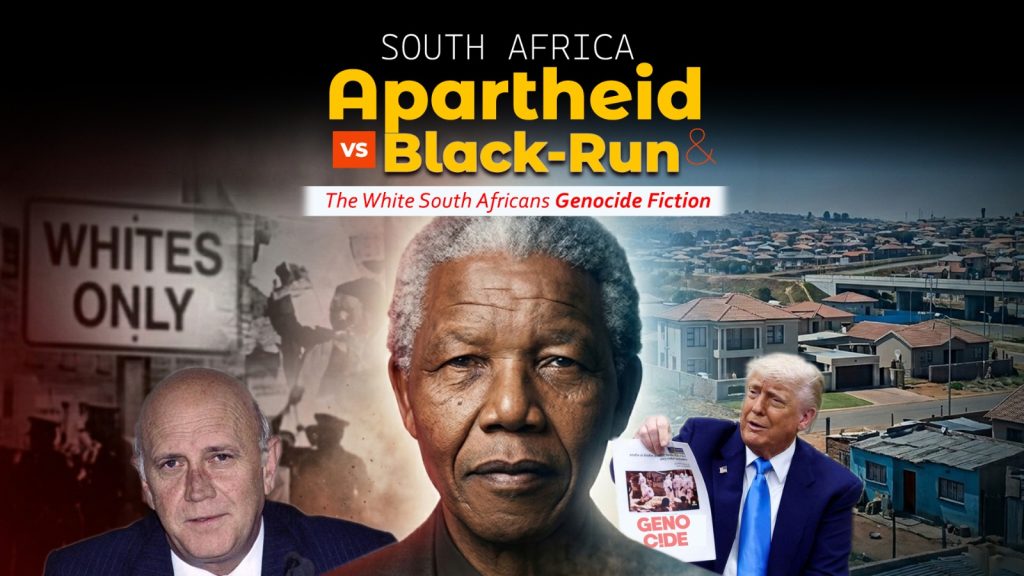
Apartheid South Africa vs. Black-Run South Africa and the White Genocide Fiction
In this video, I want to present a different perspective. I will explore the complexities of apartheid and white-ruled South Africa before 1994, as well as the claims of white genocide often made by Donald Trump and many white conservative Americans, in contrast to black-run South Africa today. I approach controversial topics without bias, aiming for a fair analysis.
I find it very amusing how white people have ignored what apartheid truly was and focus only on the developmental and creative side of white people, especially in South Africa. Some terrible, terrible things went on in South Africa, which led to the black abysmal rule that we see today.
Everyone knows that giving South Africa to white governance would transform it into a thriving nation within two decades. You know, I know, and everyone knows this, even black South Africans. However, the dominant white narratives on social media—including platforms like YouTube—have diminished the significance of apartheid, treating it as if it were merely a myth. Thus, what exactly is apartheid?
Apartheid, which means “separateness” or “apartness” in Afrikaans, was a legalised system of racial segregation and white supremacy in South Africa, enforced by the National Party government from 1948 to 1994. This system mandated that racial groups live in separate areas, controlled where Black individuals could live, work, and travel, and denied them political rights, such as voting. It also led to the creation of separate schools, hospitals, and public spaces.
While Black South Africans bore the brunt of apartheid’s violence and discrimination, the Dutch descendants and the British enjoyed the privileges of the superior race, treating Black people as their subordinates. Indians and people classified as “coloured” also suffered under apartheid; however, their experiences were somewhat less severe than those of Black Africans. ‘Coloured’ individuals, a term used in South Africa to refer to people of mixed race—such as those with white, Asian, or Black ancestry—still faced significant humiliation, segregation, and displacement compared to whites.
When did the Europeans arrive in South Africa?
The arrival of Europeans in South Africa began in 1652, when the Dutch East India Company established a settlement at the Cape, now known as Cape Town. Dutch settlers, referred to as Boers, expanded inland, often displacing indigenous people in the process. In the early 1800s, the British took control of the Cape Colony. This period marked significant land dispossession for African communities and the introduction of slavery and forced labour, leading to an increasing racial hierarchy. In essence, one white group—the British—colonised another white group: the Dutch settlers at the Cape, and this affected various regions of what is now South Africa.
Even before apartheid, laws that enforced racial inequality were foundational to the land now shared by whites, Asians, blacks, and coloured people—a true Rainbow Nation. The Union of South Africa, formed in 1910, unified the British colonies and Boer republics but excluded black South Africans from political power. The Natives Land Act restricted black Africans to about 7% of the land. Although apartheid was officially established in 1948, its roots had already been present for over a century.
There is no right granted to Europeans to sail across the world, seizing lands already occupied by their indigenous inhabitants, invading them, imposing their own rules, and then claiming, “Oh, under our rule, the country became well-developed,” without acknowledging the brutal racial policies that forced the white government out of power. From 1700 to 1994, a span of over 200 years, black South Africans lived in their native land as though they were animals among foreigners whose indigenous land is more than 13,000 kilometres away.
What happened in South Africa is similar to what took place in Australia, New Zealand, the USA, and Canada. Europeans travelled the world, seizing lands and establishing new white-dominated countries. However, in South Africa, this approach faced significant challenges because Africa was the indigenous homeland of the black population. There were millions of black people living there, making it impossible to displace them in favour of white settlers.
As colonialism in Africa became increasingly problematic, the rise of independent black nations on the continent intensified the pressure on the minority white leadership. People increasingly saw this situation as an invasion rather than a typical colonisation. Consequently, the minority white government gave in to the indigenous people who had lived under oppression for centuries. Unlike the whites, the blacks sought an inclusive government and abolished racial policies, seeking no retribution. I want to repeat this statement: There was no widespread, violent retribution or “Nuremberg-style” trials in South Africa after apartheid ended in 1994. Instead, the country adopted a policy of reconciliation, with the Truth and Reconciliation Commission (TRC) at its centre.
Black South Africans are aware that whites would do better at development or running the country. However, given the pain caused by apartheid, they would rather die in their incompetence than return to being ruled by white people, even though this new generation of white people does not necessarily harbour apartheid tendencies. If the white people had established a system that treated black South Africans with dignity and respect, the poor leadership we are witnessing in South Africa today may have never emerged.
South Africa pre-1994:
In 1980, South Africa’s GDP was approximately $85 billion, making it the largest economy on the continent. By 1990, this figure had risen to around $118 billion. During the early 1980s, the South African economy experienced a temporary boom driven by a record-high gold price; however, it was structurally weak. Despite strong nominal GDP growth, the decade saw declining growth and high inflation rates of 12-15%. Inflation remained persistently high throughout the decade, consistently exceeding 12%.
The mid-1980s witnessed a debt crisis and capital flight, leading to a sharp decline in the rand’s value. By 1990, the South African economy was stagnating, with GDP contracting by 0.3%. Although it remained the largest economy in Africa, it faced severe international sanctions, high unemployment, and significant structural challenges, leading to a decline in real per capita GDP.
In 1994, black South Africans, under the leadership of Nelson Mandela, inherited a deeply distorted “dual” economy from the apartheid regime. The white minority concentrated wealth in their hands. At the same time, the black majority faced immense poverty, high unemployment, low-skilled jobs, and restricted access to land, education, and basic infrastructure. It’s important to note that many black South Africans had never governed a country before and lacked access to education, which contributed to leadership challenges. The transition was daunting, especially considering the historical context—only 30 years ago, many black South Africans had endured generations of humiliation and oppression. This legacy made it difficult for them to accept leadership from the same group that had previously subjugated them. As a result, many black South Africans continue to support the ANC, despite criticisms regarding their competence, rather than the historically dominant, racially motivated white leadership.
The Trumpists and the Conservative Claim of White Genocide in South Africa:
It is ironic that certain advocates and some conservative Americans and Europeans do not consider what we all clearly observed in Gaza to be genocide. Yet, we hear claims that the white South Africans—who are the wealthiest individuals in both South Africa and the entire continent, living in luxurious homes and enjoying privileged lives—are victims of genocide simply because black people are in charge of the country. Really?
I refuse to remain silent in the face of injustice. In 2023/24, there were a total of 27,600 murders in South Africa. Can you guess how many of those were white victims? Under 2%! The following year, in 2024/25, there were around 25,000 murders. Take another guess? Once again, under 2% of the victims were white.
Between 2020 and 2024, approximately 225 people were killed on farms. Among the victims were 101 black workers and 53 white farm owners or their relatives. This data indicates that criminals targeted certain farms, resulting in a disproportionately higher number of black victims compared to white victims.
Furthermore, the number of businesses attacked and robbed in a single U.S. state within one month exceeds the total number of white farms attacked in South Africa between 2020 and 2024. If this situation were labelled as genocide, then the vast majority of black Africans would prefer to live under the conditions of white South Africans, with the finest homes in Africa, the highest number of millionaires, the highest average income, and many more.
Comparing Gaza and the situation of white South Africans, using the term “genocide” in relation to the latter undermines the significance of the word itself. Data suggests that in countries like the U.S., the U.K., France, Canada, Sweden, and Germany, a white person is statistically more likely to be attacked by a black person than in South Africa. Between October 2025 and March 2026, the United States admitted 4,499 refugees, all but three of whom were white South Africans. I understand that a white person would likely defend another white person, but do so openly, as black people do. Don’t invent fictitious claims of genocide.
Black Run South Africa:
There is no doubt that the ANC and the South African black government have performed poorly. The infrastructure built by the whites using black people as indentured servants under harsh conditions has deteriorated. In other words, the people who put in the manual labour into building the white man’s brainwork have destroyed South Africa. Why? Because blacks are incompetent—period. In South Africa, towns and cities managed by white people tend to be well-maintained, whereas those managed by black people often show signs of poor management. White people build, black people destroy; it is that simple. Get furious all you want. It’s important to recognise that black South Africans endured decades of apartheid, along with a similarly oppressive regime for over two centuries.
They were not granted the same access to quality education as white people; instead, they lived in shantytowns and neglected areas. They faced humiliation and were thoroughly deprived of the same opportunities as their white counterparts. It is unreasonable to expect that, suddenly in 1994, with the end of apartheid, everything would operate on the same merit as if the blacks were capable of competing with whites on equal footing. While I acknowledge that the black leadership contributed to the country’s decline through incompetence, it is essential to examine history to understand the factors that have led to the current situation in South Africa. This context should never be overlooked when discussing the nation’s recent struggles.
Should leadership be returned to competent white individuals? Absolutely! This situation would never have arisen in the first place if whites had treated blacks with dignity and humanity. They could have established their country in South Africa and restricted blacks from entering it. In that case, blacks would have been free, living in a separate Black South Africa, indulging their incompetence to themselves. Most people would rather be poor and underdeveloped with their dignity, culture, language, and humanity intact, instead of living in a developed land where they are treated as subhumans.
No one would easily vote for a group that subjected their parents to brutal humiliation, torture, imprisonment, and even death for over two centuries. This ended barely over 30 years ago; even I can remember it. In Central Africa, we wept, mourned, empathised, and grieved with our black brothers and sisters in South Africa. I can still vividly remember it. Jews today still remember the traumas they endured at the hands of the Germans over 80 years ago. Similarly, the barbaric treatments faced by Koreans under Japanese occupation or by the Chinese during the same period are not forgotten. Additionally, the experiences of Americans in Iran during the 1979 revolution are still relevant today, which is one of the reasons the orange guy at the White House still harbours such animosity towards the Persians of Iran. How dare you assert your independence and even possess a higher average IQ than we do!
Given this historical context, would you vote for the whites if you were a black South African, especially given how very recent apartheid was?
I understand that Black people, like South Africans, need to move forward. However, if you have never been a victim, it can be difficult to truly understand their experiences. The rhetoric from some white conservative Americans about a so-called white genocide in South Africa prompted me to investigate further. What I discovered made it easier for me to create this video, as I could not accept that misleading narrative.
This situation is why some Black individuals perceive a white supremacist mindset among whites. When one white man defends another white person in South Africa—who is living comfortably and even being granted a free pass to the U.S.—while ignoring those who are genuinely suffering persecution, it fuels these accusations.
The media and so-called experts often repeat the same misleading claims, which have led many white people to harbour negative feelings towards blacks. To them, “Black” equates to “African”, and “African” means killing white people in South Africa. This level of geographical illiteracy is hypocritical for a group that claims intellectual superiority.
Watch the video version on YouTube at: https://youtu.be/EpLEeXB_oQw
By Ikechukwu ORJI