Nigeria: A Land Where Everything Is Imported
Nigeria currently has a population of 237 million, projected to reach 300 million by 2035. The men and women of Nigeria are hard-working individuals, and they deserve recognition for their efforts. In just ten years, Nigeria’s population is expected to increase by an amount comparable to the entire population of countries like Colombia, Italy, South Korea, Spain, or Canada. Remarkably, in the next decade, Nigeria will produce more people than the total number of African Americans.
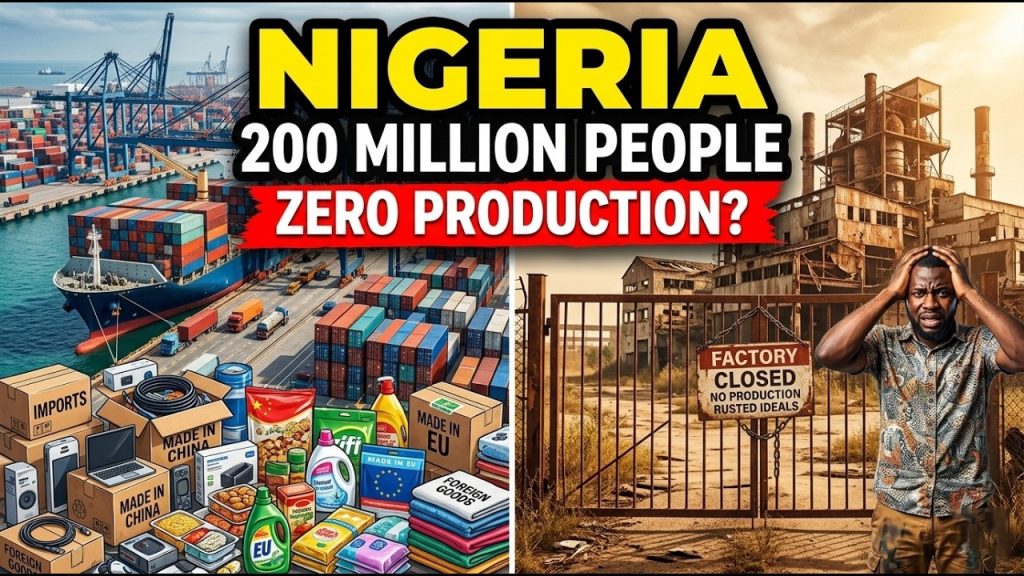
However, what is striking about Nigeria is its heavy reliance on imports. Everyday items such as body lotion, shower gel, soaps, cables, chargers, mixers, fryers, bulbs, knobs, tiles, and even the traditional African fabric known as ankara are imported from countries like China and various European nations. It’s important to note that I’m not even discussing advanced technology here; I’m referring to some basic essentials that a ten-year-old Chinese or Korean can produce in their backyard.
Ironically, when ships deliver their cargo to Nigerian ports, they often leave with empty containers because the country produces almost nothing it can export.
When vessels offload goods in countries with intelligent labour forces, they don’t leave empty-handed; they take locally produced goods with them. For instance, Indonesia, with a population of 287 million, has over 100 seaports. Vietnam, with 102 million people, has 34 seaports. The Philippines, home to 116 million people, has 17 major seaports. South Africa, with 65 million people, has 8 major seaports, while the smaller nations of Bahrain, Qatar, and Kuwait have 4, 3, and 3 major seaports, respectively. In contrast, Nigeria, with a population of 237 million, has only 1 major seaport located in Lagos.
So why is Nigeria so reliant on imports? First and foremost, it lacks the infrastructure and expertise to become a manufacturing powerhouse. A key requirement for industrialisation is a reliable electricity supply, but Nigeria lacks sufficient generating capacity. For over 40 years, Nigeria’s electricity output has not increased commensurate with its population growth; in fact, it has decreased disproportionately. To illustrate, Nigeria’s population was 87 million forty years ago; today, that number has increased by over 200%, yet electricity generation has plateaued or declined. If you don’t generate enough electricity, you cannot industrialise.
Nigeria lacks factories. As you travel throughout Nigeria, five major types of businesses stand out: churches, restaurants (including bars and nightclubs), banks, small fashion shops, and beauty salons. There are no factories, little innovation, and minimal productivity; instead, imports flood the market. Nigeria is one of China’s largest dumping grounds for a wide array of low-quality Chinese goods. Many of these imports lack English instructions and may only be usable for a brief time. Because the country has no standards, virtually anything can be imported and sold, regardless of its usefulness to the buyer, whether it lasts for an hour or a week. Refunds and returns are not offered, and there are no regulations—or if they exist, they are not enforced. The system is entirely broken.
It’s important to acknowledge the hardships Nigerians endure. We need to commend them for their resilience in navigating life in this country. In the past three months alone, I have spent over $1,500 on electricity bills for my home in Lagos. I mention this because it highlights the situation. The minimum wage in Nigeria is ₦70,000 per month, about $50, while the average salary is ₦250,000 per month, about $180. For context, the average monthly salary in the US is $5,800, which is 32 times higher than in Nigeria. Yet, electricity costs in Nigeria are NGN 225 per kilowatt-hour (kWh), approximately 16 cents, the same rate that Americans pay. As a result, Nigerians pay the same price for electricity as those in the developed world, despite earning significantly less on average. On average, Nigerians pay more than the rich in developed countries.
Sub-Saharan Africa imports approximately 6.5 million premium motor spirit (PMS) generators, with over 3 million going to Nigeria alone—almost half of the total. Nigeria is often referred to as the land of generators, yet for more than 40 years, there has been no investment in domestic research to produce them. From clothing to toilet paper, from screwdrivers to toothpicks, Nigerians import all their everyday needs, with China accounting for a significant share of these goods.
All of these imports flow through a single seaport in one city, despite Nigeria’s coastline stretching over 800 kilometres. This concentration of logistics and financial activities in Lagos has led to considerable traffic and pressure on the city, driving many Nigerians to migrate there. As a result, Lagos has become home to over 20 million people, while the total road length in its greater area is less than 10,000 kilometres. For comparison, Amsterdam, with a population of less than 1 million, has a road length of 10,000 kilometres, and Dubai, with 4 million residents, boasts over 18,000 kilometres of road.
In Nigeria, private generators produce nearly 20 gigawatt-hours of power annually, accounting for roughly 96% of industrial energy consumption. I want you to picture the level of carbon monoxide gas emissions in Nigeria. Carbon monoxide (CO) is an odourless, colourless gas that can cause sudden illness and even death if inhaled. This danger occurs when carbon monoxide accumulates in the bloodstream. When there is too much carbon monoxide in the air, it can replace oxygen in red blood cells, leading to severe tissue damage or even death. Nigerians have one of the shortest life expectancies in the world, averaging just 54 years. Could this be a contributing factor to their early mortality?
Despite this situation persisting for over 40 years, little has been done to address the problem of inadequate power generation and the hazards involved with premium motor spirit (PMS) generators. This lack of reliable electricity has stifled local production, forcing Nigerians into a cycle of dependency on imports. Over 75% of Nigeria’s population is under 40, meaning most grew up in a culture of dependence on imports rather than on productivity or local manufacturing. Factories and businesses that once supported the economy in the 1970s and early 1980s have since disappeared, leaving the economy unsustainable.
Nigeria consists of 36 states, each governed by an elected governor, and has a president elected by popular vote. Every month, after the federal government receives revenue from crude oil production, it distributes payments to the 36 governors to help manage state infrastructure and affairs. These governors typically use this funding to pay salaries and cover other state expenses. However, many states struggle to generate their own internal revenue, leading to a cycle of dependency on federal remittances. This reliance has stifled the independent thinking of many Nigerians, making it difficult for them to innovate or explore new ideas.
Unfortunately, this situation has also contributed to widespread corruption. Some governors may embezzle a portion of monthly funds, neglecting to pay pensions and salaries and to maintain infrastructure, without facing repercussions. Corruption accusations against governors are common, yet very few have ever been convicted despite the substantial evidence of potential embezzlement.
Importing is not inherently negative when it is properly regulated and controlled. However, when an entire nation of 237 million people relies on imports for everything they need, without regulation or oversight, it undermines local production, creativity, and competition. Instead of striving to invent, produce, or manufacture the best products, Nigerians end up competing to see who can import the best ones. This is not an effective way to run a country.
Currently, fewer than 5% of Nigerians have ₦1 million ($725) in their bank accounts, and fewer than 3% have savings for the future. The Contributory Pension Scheme (CPS) covers only 10 million Nigerians, and over 70% of cars in Nigeria have insurance. From homes and workplaces to schools and government buildings, many Nigerians do not invest in insurance or protection for their future. The absence of a maintenance culture and strategic foresight has significantly hindered Nigerians—and, more broadly, black Africans—from developing and sustaining themselves.
Watch the video version on YouTube at: https://youtu.be/aRJr8_hHNRE
By Ikechukwu ORJI