The Caricature Economies of Black Africa
By now, we all know that Africa is poor. But when we say ‘poor,’ a person in Norway, Japan, Austria, and other developed countries may not understand. For example, we have poverty in the UK, but someone living in poverty is someone who earns below 60% of the UK median income of £39,039, which is roughly £24,000 per annum. Whilst a person living in poverty in Nigeria, Ghana, Cameroon, the Central African Republic, Sudan, Guinea-Bissau, the two Congos, and many other African countries makes about £600 per annum. See the difference?
Therefore, when people in the developed world hear that Africans live in poverty, they don’t quite get the picture. What that means when it comes to Africa is that they live lives of indigence, or near-total deprivation of basic human requirements. In this video, we will examine the revenue streams and economic models of various African countries, then explain why they are unlikely to succeed economically.
Let’s start with Rwanda. The country is so clean and tidy, yet poor. In 1994, a genocide ravaged the country; you know it, I know it. Now let’s move on. Paul Kagame took over control and has done wonders. It even ranks 43rd on the corruption index, higher than many EU countries, including Czechia, Spain, Italy, Poland, Greece, and Slovakia. The structure in Rwanda is so stable and transparent that it’s hard to understand why investors aren’t pouring into the country.
Firstly, Rwanda is Black. There is a reputational issue with Black people. Manufacturers and corporations typically don’t have Black Africans in mind when they design products. There are no Apple Stores in all of Africa. Many companies you see on the high streets in London, Los Angeles, New York, Paris, Berlin, Tokyo, Seoul, or Sydney have no business with Africa. Even though there is a larger market for Apple iPhones in Nigeria, Angola, Tanzania, or Kenya than in Austria or Belgium. Even if Rwanda were safer than Japan, cleaner than Singapore, and had a higher IQ than Taiwan, Western corporations and businesses would still not pour in. Why? Because of the Black reputation. This is why, even in a country as organised, clean, and safe as many Western countries, Rwanda still relies on American and European aid, because investors are not pouring in.
Let me digress for a bit! You know, during and after the Rwanda genocide, why didn’t other African countries help? You only hear about European and American aid. How much aid has Gabon given to other African countries? How much assistance have the different African countries given to their neighbours? You don’t have to be a billionaire to help others. If you can’t help others when you are worth £10,000, you won’t help them when you are worth £10 million. Africans don’t have a universal African charity system. It doesn’t mean they are evil; it is just not ingrained into their culture. There is no such thing as predictive analysis in the African worldview. There is only the now and now only.
Go to the various African countries, and you’d find Europeans and American whites who have dedicated their lives to working for charities to save other Africans for free. How many Nigerians, Ghanaians, Ugandans, or Congolese have you seen dedicating their lives to working for free in Nepal, Bolivia, or Syria? In fact, if you told other fellow Africans that your ambition was to dedicate your life to helping poor people, they’d think you’re crazy or acting white.
Rwanda’s total revenue in 2025 was $5 billion, compared with $12.7 billion for Ireland’s cheap-clothing brand Primark in 2024. Its latest FDI numbers are $820 million.
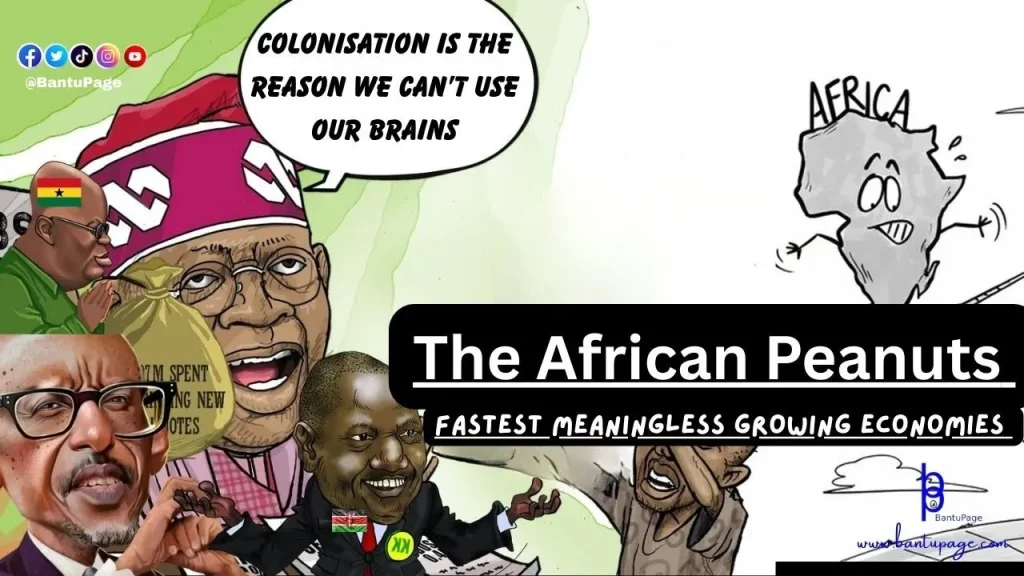
You see, of the top 10 fastest-growing economies in the world for 2025, six are African. Do you know which countries these are? South Sudan, Guinea, Ethiopia, Rwanda, Libya, and Uganda. The second place is South Sudan. Its GDP is $3.9 billion, which is slightly more than the London and New York State police budgets. So, even if they made $800 million, that would be a 20% increase. Whereas, with Denmark’s GDP of $431 billion, $10 billion would only amount to about 3%. But on paper, South Sudan grew by more than 20%, while Denmark only grew by 3%. These uneducated Black people would run around bragging about how Africa is the future. Remember, Denmark has less than half the population of South Sudan. The story is the same for the other five African countries on the list. In fact, do you want to hear the interesting bit? Gaza and the West Bank came third on the list. Even my piggy bank is seeing a 30% weekly increase, because 30 pence on a pound is a 30% increase.
Let’s jump to Ghana. Its total revenue generation for 2025 was around $20 billion, against $25 billion in expenditure. Its outgoings involve employing Chinese and other foreign countries to build roads and other infrastructure. Like Rwanda, Ghana isn’t attracting investors. But unlike Rwanda, Ghana isn’t that safe, clean, or transparent. However, even if Ghana had all of the above, it is still Black. Top investors would still not come.
In contrast, Belgium, with 11 million people, three times less than Ghana, generated $428 billion in 2025. Ghana, like Rwanda, has no manufacturing capacity or any novel technology it can offer the world. The only companies you see rushing into Black Africa are those that mine its natural resources or build infrastructure. Every now and then, you get some irrelevant Indian, Chinese, or Western companies investing in some African country with no real impact or significance. African economies cannot grow or attract investors as long as they lack novel technologies that would appeal to the rest of the world. Ghana’s latest FDI is $863 million.
Flying off to Kenya, East Africa’s largest economy. It, too, is no different. Its revenue comes from taxes, agriculture, and other minor sources. Its latest FDI numbers are $463 million. Its total revenue for 2025 is $26 billion. Let’s compare that to Norway’s $230 billion. Note that Kenya has 57 million people, compared to Norway’s 5 million. It will be challenging for Black Africa to attract top investors even if the turf ticks all the boxes. Black Africa’s reputation is its greatest economic killer. Until Black people go through a century of top-notch etiquette, rebranding, and consistently changing the image that they have sold to the world so far, no matter whatever genius economist takes charge, it is not likely to change as much as a non-Black country would.
In most Black African countries, revenue is generated from natural resources and then split among the provinces, states, or departments. They share it and wait for the next month. Nigeria is the perfect example of this. The former French colonies in Africa are tied to two currencies that are backed and regulated in France—the West and Central African Francs CFA. A few years ago, a Zimbabwean woman named Arikana Chihombori-Quao, who lives in the US, worked as a medical doctor. She’s the embodiment of the African Wakanda movement. The African Union appointed her as ambassador, where she brought that Wakanda madness from the US into the African Union. She claimed that France benefits from $500 billion in annual interest from its former African colonies. Since Black people don’t like reading, the story spread throughout Africa.
Let me break this for you. The GDP of all the former French colonies in Africa is less than $350 billion, and they collectively generate less than $200 billion annually. How, then, can your annual interest be $500 billion? This lady, Arikana Chihombori-Quao, who isn’t trained in finance, went with this narrative on many Black channels, and you should see them condemning France and buying into her Wakanda fiction. It took me seconds to debunk her. She was fired from her role by the African Union. Oh boy, you should see how many Black people ran their conspiracies. The African Union are working with France and the whites to keep Black Africa poor.
Unless an African country invents some technology that would change the world, no Black African country would develop to the level of those in East Asia and Western Europe.
Moving on to the saddest case of them all. South Africa! You see, South Africa’s case is so unfortunate that it defies comprehension. It’s like your chef cooked your meal, left it in the kitchen, and you have no clue how to serve yourself. White people did all the work and gave a perfect country to the Blacks, and they had no idea what to do with it. Then Zimbabwe’s case is even sadder. Many may not realise this. The white farmers in Zimbabwe employed black Zimbabweans. So, they did the job under the instruction of the white farmers. They saw them do it and worked with them for years and years. So, you have no reason not to continue doing what you did under the whites. But no! As soon as Mugabe’s farm grab policy was enacted, the same Black people who had been working for the white for years, slaughtered them, seized the farms and looted the crops. When the farm had no crops, fruits, or edible plants, they chopped down the trees and bushes for firewood. When there were no more crops or firewood, they slipped back into starvation and poverty. You cannot make this up! Such a level of foolishness would not be believable in 200 years, even when taught in history classes.
In conclusion, the Black African’s first downfall is being Black. Second is the lack of knowledge or low IQ; third, its tribal nature; fourth, its culture; and fifth, its worldview. Changing the last four would change how the world sees Black Africa. When that happens, being Black would no longer be a detriment.
Solution: I propose that African countries be managed like corporations, by appointing competent white Europeans or North Americans, Japanese, Koreans, or Chinese as CEOs to run the various African countries. All ministers and government officials should be relieved of their duties and replaced with competent individuals from these regions to elevate African nations to new heights. The last sixty years have proven that we can’t run ourselves. There is no shame in acknowledging this reality.
It’s normal in every other human endeavour that when you don’t know something, seeking help from those with a track record of success is a pragmatic step, not a source of shame. Consider how the Gulf states have flourished under the guidance of international professionals who designed, built, and continue to operate their infrastructure. Perhaps it is time for Africa to embrace a similar path to transformation.
Watch the video version on YouTube at: https://youtu.be/K1nRluFNl8k
By Ikechukwu ORJI