The African Stunted Childhood, Decrepit Infrastructure, and Derelict Schools; Africa Struggles to Nurture Academic Brilliance On Par With the West and East Asia.
In this article, I will walk you through the development of Africans from childhood to adulthood and compare it to the experiences of individuals from Europe, North America, Korea, China, and Japan during the same stages. The challenges faced by Africans are cultural, not inherent. Africans have not developed a comprehensive understanding of the mathematics of setting up societal structures that benefit everyone. Black Africans tend to be self-centred; they are often not raised to prioritise selflessness or charitable acts for the betterment of their communities, towns, cities, or countries. This cultural backdrop may explain why altruism and philanthropy are less common in Africa.
Let’s use Nigeria as our example. The reality in Nigeria is quite similar to that of Senegal, Kenya, or Angola, despite these countries being thousands of kilometres apart. It’s fascinating how alike Black Africans are, which makes it perplexing to me why there is so much animosity between them.
A child born in Nigeria is often given a foreign name and is taught that either Jesus or Mohammed is their saviour or path to heaven. The parents typically have no plan or understanding of long-term employability, business opportunities, or income stability. They are often indifferent to the political climate, the state of the economy, or whether their environment is suitable for raising children.
By the age of five, the teachings of Jesus or Mohammed become central to that child’s worldview. They attend church or a mosque several times a week and begin primary school, where resources for early education are severely lacking. Instruction is often given in a form of English that deviates from its original or standard version, following an outdated curriculum.
By the age of ten, that child may struggle to speak any language fluently at a mother-tongue level. They have not gained meaningful knowledge from their education and often face challenges, such as being expelled from school for unpaid fees, resulting in significant gaps in their learning.
Furthermore, this child often lacks a personal room and shares cramped living space with siblings. They lack comfort, access to books and study materials, and the peace necessary for learning and mastering new skills, given the difficult circumstances in which they were raised.
The curriculum focuses more on learning to speak a form of quasi-English and mastering religious texts like the Bible or the Quran than on actual academic study. The boy frequently gets expelled from school due to non-payment of fees, yet his parents continue to have more children than they can adequately care for. By the age of 15, school has become just a mandatory place to attend, rather than an environment that nurtures genius or skills that contribute to the country’s development. The mother is already on her fifth child, exhausted and unable to attend to her older children, who are all over ten years old. Meanwhile, the father struggles to make ends meet, leaving him little time or energy to check on his child’s academic performance. By this age, the child’s heroes and role models tend to be Nigerian social media influencers—often shallow, half-naked, loud, and aspiring celebrities in the Afrobeat scene or other viral stars. The child’s ambition is to move to the United States or Europe for further studies, as the local universities and institutions of higher learning are poorly equipped, rundown, and just as outdated as the primary and secondary schools they attended.
By the age of 18, many boys in Nigeria have spent a significant portion of their lives raising their siblings, as families often have numerous children. Children are stepping into parental roles while their parents are busy having more babies, believing it to be a blessing from God. Only about 2% of these youths obtain a student visa for the UK, the US, Canada, or another country—those who succeed graduate from Western universities and often do not return to Nigeria.
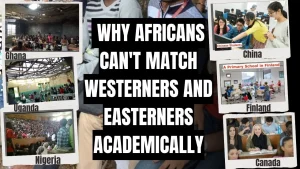
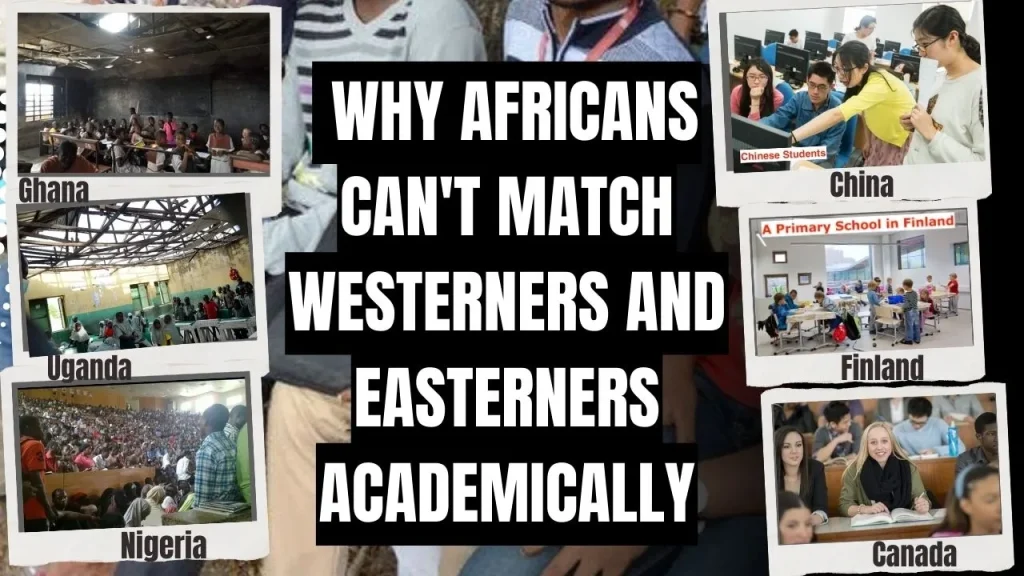
Meanwhile, around 90% of graduates from Nigeria’s outdated, poorly equipped universities earn degrees in Mass Communication or Computer Science, despite never having seen an actual computer during their studies. Many students miss classes—about 60% of the time—because universities are so overcrowded that 30% of students lack classroom seats. Professors frequently arrive late and spend their time imposing strict religious guidelines rather than providing a quality education. As a result, no one who grows up in Nigeria can achieve the same level of education as those in Western countries or East Asia.
Don’t get me wrong; what I’ve just described reflects the reality for most Nigerians. Only about 5% of the upper class attend private schools, where the educational system is somewhat different and slightly improved. However, the polychronic nature of Nigerian culture and a general lack of discipline dominate the academic landscape. Whether in private or public institutions, professors and teachers often arrive when they choose, and some may even engage in inappropriate relationships with students in exchange for grades. Many of these educators are ill-equipped to teach effectively. As a result, unless you are naturally gifted, your chances of succeeding in comparison to East Asians—who are making strides in AI and other STEM fields—are slim. The Black African have no chance at all. Often, when a Nigerian or an African breaks some academic record, they usually live and study in the West under the guidance of white people.
In contrast, the Western child enters the world as a result of two parents who prioritise their own needs first. These parents have planned their lives together, carefully considering how many children they can have. They have savings, stable jobs, and a decent home. The education system has an updated curriculum, with quality free schools available in every town or local area, supported by the local council. Additionally, an emergency system is in place for unforeseen events. This child does not feel pressured; they have their own room and loving parents who teach them their mother tongue, which they speak faultlessly.
By the age of ten, a child in the West typically has their strengths identified by parents who often focus their attention on one or two children. These parents encourage their kids to engage in various activities such as swimming, playing football, trying the piano, going on school trips, reading contemporary books, and participating in extracurricular pursuits. The emphasis is placed on nurturing their strengths. By the age of eighteen, these European children are often in university, studying subjects they are passionate about without feeling pressured.
Supported by the West’s monochronic culture, teachers and professors value punctuality. They are regularly evaluated, and adherence to rules is considered sacred and non-negotiable. As a result, these children benefit from a standardised education system that consistently delivers on its promises, unlike their African counterparts, who have no time for extracurricular activities. Evidence shows that students who participate in extracurricular activities are more likely to excel academically and develop essential life skills.
If students study Computer Science, they are equipped with modern computers and taught relevant courses that address current and future realities. In contrast, many Nigerian and African children graduate with a degree in computer science without ever having seen a computer. Their classrooms often lack reliable electricity, running water, and adequate infrastructure, making it challenging for them to learn. How can we expect Africans to grow or succeed when they face chaos and an unstructured upbringing, lacking the basic infrastructure needed to thrive?
Whether in Nigeria or Senegal, Angola or the Democratic Republic of Congo, Kenya or Tanzania, Mozambique or Uganda, Niger or Burkina Faso, Mali or Ghana, or Liberia or Sierra Leone, the reality across Africa is quite similar. In urban areas or metropolises such as Nairobi, Dar es Salaam, Luanda, Accra, Lagos, Maputo, or Dakar, about 20% of the upper class experiences differ from the norm. However, their lifestyles still do not compare to those of the average child in Western countries.
An 18-year-old student from England, Germany, France, Denmark, Japan, Korea, China, America, Canada, Australia, or New Zealand typically speaks their mother tongue fluently and excels in their chosen field. In contrast, an 18-year-old student from Nigeria, Ghana, Senegal, Mozambique, Uganda, or the Democratic Republic of Congo may struggle to speak any language at a native level.
Africans speak English, French, or Portuguese, but often with limited proficiency. This language barrier, combined with a lack of academic skills and the impact of our tumultuous upbringing, poses significant challenges. Many grow up in chaotic environments filled with noise, numerous siblings, and parents struggling to support more children than they can effectively care for. As a result, we face difficulties competing globally. Until we address these issues, nothing will improve or change. The troubling part is that Africans do not see or think that they have a problem. They’ve reached the peak of their evolution.
Let’s look at the Potential Solution:
What can we do to fix the problem? It may not be something we can fix; we are simply being ourselves. We have not evolved to the same level as Western and East Asian societies. Our struggles stem from trying to adopt a system that is not inherently ours. For many black Africans, the concept of a country is foreign; we often view countries as one big ATM to plunder.
If we want the current system to work, we need the guidance of those who introduced it to us. However, this would imply a return to European rule, which is something that many black people oppose vehemently. As a result, we may find ourselves caught in a cycle of turbulence, potentially indefinitely, because we still lack the knowledge and skills that Europeans and East Asians possess to structure systems effectively. We must humble ourselves and bring in those with a proven record in structuring systems. There are no shortcuts here.
We face a choice: either revert to the ways we lived before colonisation or remain in this confused state, continue blaming all our problems on colonisation and the white man.
Watch the video version on YouTube at: https://youtu.be/RRcRpgjYENI
By Ikechukwu ORJI