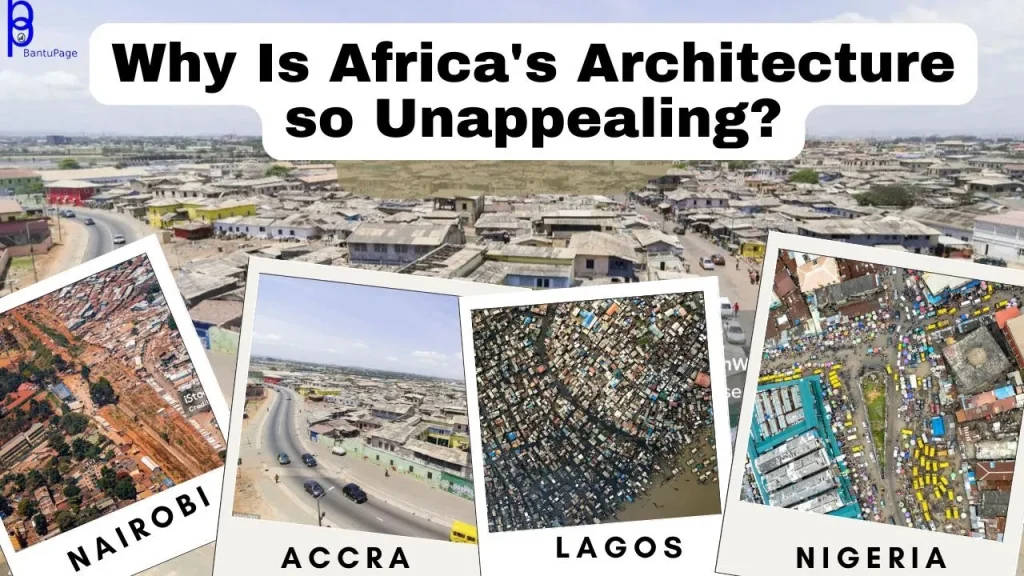
Why is African Architecture so Unappealing?
The world has made significant progress over the years, but this progress seems to apply primarily to Europe, East Asia, and other regions outside of Black Africa. When we see cities like New York, Toronto, London, Paris, Berlin, Seoul, Tokyo, Shanghai, Auckland, and Sydney on our screens, we often marvel at their impressive architecture. Architects meticulously design each building and construct it to endure for generations, thereby contributing to the city’s identity. On the other hand, African architecture frequently resembles the work of a playful child. Seriously, what is this? What about that one over there, or this one right here?
Structures built in Europe, the USA, Canada, or Japan hundreds of years ago tend to look more modern and aesthetically pleasing than those constructed in Nigeria, Ghana, the Democratic Republic of the Congo, and other Black African countries in recent years. When Black Africans look at their skylines, do they feel a sense of shame? Buildings in Black Africa frequently seem on the verge of collapse. Most structures in cities like Lagos, Accra, Douala, Kampala, Kinshasa, Dakar, or Gaborone are less than 25 years old. Yet, they often appear old, dirty, unattractive, and poorly designed—unlike buildings in London, Paris, Berlin, Amsterdam, or Moscow that date back centuries.
Most buildings in Black Africa that are over a hundred years old were constructed by Europeans, and they still look newer, straighter, and more solid than those built by Black Africans after European colonisation. Chinese or European companies often construct the few structures in Black Africa that appear relatively beautiful or uniform. One wonders why, even in 2026, there is still a struggle with basic construction techniques involving cement and steel. How could there be such a lack of progress in designing and maintaining cities to resemble modern urban environments, rather than something reminiscent of Stone Age Europe?
No country perhaps highlights the challenges faced by Black people more than Nigeria. The linguistic decline is evident; many Nigerians under 30 primarily speak a Nigerian variant of English as their first language. Over the past 40 years, proficiency in indigenous languages has declined significantly. This trend is simply shocking! The English they adopt often resembles a blend with their local dialect, making it difficult for native English speakers to understand them. As a result, many Nigerians find themselves linguistically handicapped, unable to communicate effectively in either English or their native tongues.
In the 1970s, Nigerians proposed building a brand-new capital city in the heart of the country. Of course, they can’t build a simple 50-metre bridge, so a Japanese architect designed it, and the German company Julius Berger built it. The city opened in 1991, which is just 35 years ago. My friends, go to Abuja and see what Nigerians have turned the place into. It’s an open urinal where they urinate everywhere, even in the heart of the city. The destruction of all the bus stops, architecture, and pavements has turned the city into a pigsty. Abuja is the perfect example of why Black Africans are a danger to themselves.
Sports! An area where Black people tend to thrive. But outside football and long-distance running, Black Africans win nothing at the Olympics or in sports. The only reason Black Africans excel at these sports is that they require no infrastructure or maintenance. If running required solid infrastructure, Black Africans would not even feature in the events. Every football stadium on the continent was built by the Chinese or Europeans. And as soon as the stadium is completed, come back a few months later, and it has turned into a bush.
In contrast, African Americans and Black individuals in the Western Hemisphere tend to excel in a broader range of sports because they have access to better facilities. If Black Africans were given the same opportunities and resources, they would smash the medal record.
Anything that requires the brain and infrastructure to excel at, Black people often face significant challenges with. They live and thrive in chaos. Most won’t even understand what I’m trying to say. Nigeria possesses substantial crude oil reserves but relies on fuel imports from Europe and the US because four of its refineries are moribund due to a lack of maintenance. For over 30 years, the expenses associated with maintaining these four non-operational refineries have exceeded the cost of building two brand-new ones. This level of foolishness would smash the history books of those who’d learn about it in a few hundred years. Actually, it wouldn’t because Africa would still be too backward to justify them.
Every Black person believes in some capacity that the white man is racist and contributed to Africa’s underdevelopment. But then I ask, how do you underdevelop a place that was never developed? Black Africa is simply being itself. The pockets or vestiges of European or Western-looking infrastructure you see in Black Africa today are upgrades brought by Europeans and outsiders. They don’t understand or possess the know-how to industrialise. They are tribal people who thrive in a tribal setting. It’s either you let them go back to their tribal world or admit that Black Africa has overachieved for a people who transitioned directly from the Stone Age to the Bronze Age. It took thousands of years for Europeans to make that same transition; if Black Africans perfect this process in the next 300 to 500 years, it would indeed be an impressive accomplishment. But that’s an if for people who are urinating in public in 2026. Frankly, at this moment in time, Black Africa is simply going round in circles, destroying everything it lays its hands on.
Watch the video version on YouTube at: https://youtu.be/K1nRluFNl8k
By Ikechukwu ORJI