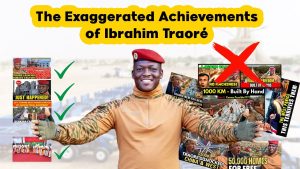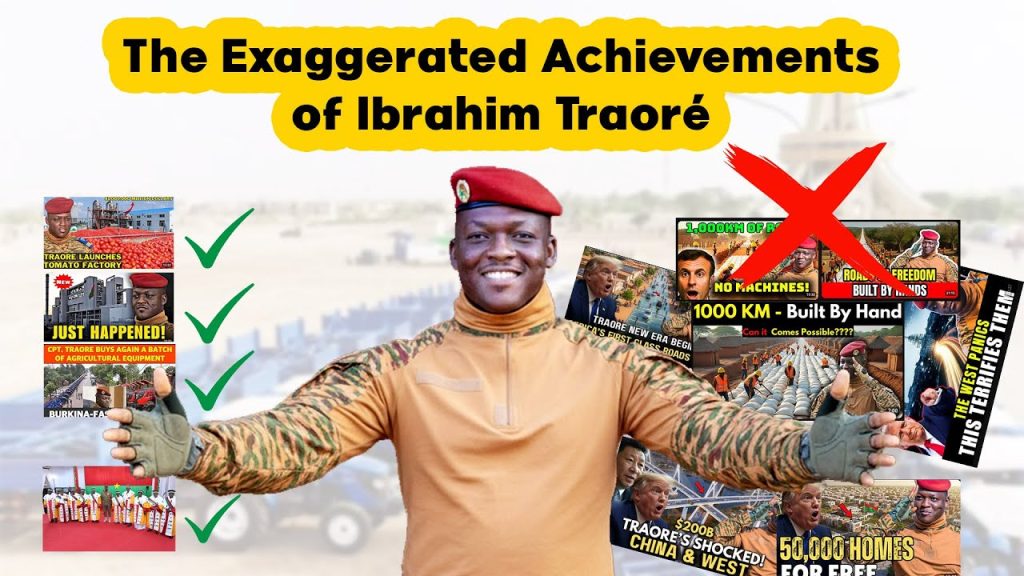
Burkina Faso: The Exaggerated Achievements of Ibrahim Traoré
Born in 1988 in the small town of Bondokuy, Traoré completed his secondary education in Bobo Dioulasso, Burkina Faso’s second-largest city, and graduated from the University of Ouagadougou. He then joined the army in 2010 at the age of 22. The young Burkinabe dictator came to power in a nearly bloodless coup in October of 2022. The GDP was $18 billion, and the per capita income was $800. In 2026, three or four years later, the GDP will have grown to $27 billion, an increase of over 60%. That is a remarkable achievement. The economy now grows steadily at around 6-7% annually. Also impressive for a young, benevolent dictator. The GDP per capita is now $1,100, a slight improvement but one nonetheless.
Burkina Faso’s entire paved road length before Traoré was 3,642 kilometres, but the young dictator has embarked on an ambitious project to construct 5,000 km of paved road connecting the country. This would be more than the country has ever built in its entire history. A 332 km 8-lane motorway linking the capital, Ouagadougou, and Bobo-Dioulasso was launched in December 2025, with work ongoing into 2026. If you go to the Wakanda channels, you’d hear stories like he completed thousands of km of roads in a year, all their usual, senseless chest-beating and braggadocio emptiness.
What inspired Traoré’s seizure of power? He was part of the coup team, led by Paul Henri Damiba, that seized power from President Roch Kabore. But Traoré and other young soldiers became dissatisfied with Damiba’s performance in failing to address the Islamist insurgency. Traoré has launched a platform to regain sovereignty and to renationalise the country’s mineral resources. Simply put, no Western power would ever again control Burkina Faso. He nationalised the Boungou and Wahgnion gold mines and transferred them to a Burkina Faso-run company called SOPAMIB. The mines were previously owned by Endeavour Mining, which also mines in Côte d’Ivoire and Senegal and is headquartered in London. Traoré also bans the export of raw gold to Europe.
His administration is building the new Ouagadougou-Donsin Airport. It has launched several “Made in Burkina” projects, including tomato-processing plants, a cement factory using local materials, and a cotton-processing plant. To my surprise, he has rejected financial assistance from the IMF and the World Bank, focusing instead on generating internal revenue. His supporters would like you to believe that he successfully cleared all the country’s debts. That is untrue! Burkina Faso remains significantly indebted, with arrears of about $5.6 billion. Nonetheless, I’m still impressed by his refusal to accept IMF and World Bank loans, because Africans are quick to stretch out their hands for handouts, which go straight into the pockets of their overweight leaders. However, Ibrahim Traoré declined. He is not corrupt. He has no intention of becoming rich while his people are poor.
His government distributed hundreds of tractors, tillers, and motorised pumps to farmers to boost food security, while local production of wheat, rice, and millet has increased significantly. He also established state-owned dairy factories and increased local cotton processing capabilities. Note: This is a young soldier with little experience but showing fantastic leadership qualities and great altruism.
Traoré expelled French special forces, ended military agreements with France, and banned French media (RFI, France 24). He and his neighbours, Mali and Niger, have formed an alliance called AES, meaning “Alliance des États du Sahel” (translated into English as “The Alliance of the Sahel States”). These three countries were kicked out of ECOWAS and AU, the West African and African versions of the EU or GCC, because of the coup d’état that toppled democratically elected presidents in those three countries. So, they said, ‘To hell with ECOWAS and AU.’ They formed their own union, issued their own passports with visa-free travel, and launched a confederal bank for investment and development. Yes, these three countries are poor, but Traoré is showing ideals that could propel Burkina Faso toward nation-building: an identity, self-belief, and, most importantly, room to think big and take risks. This has been missing in Africa since independence.
Once upon a time, his predecessor, Thomas Isidore Noël Sankara, one of the finest Black Africans who has ever lived, had similar ideals in the 1980s. Traoré risks stifling his country with the incessant blame on France and the West. Burkina Faso’s failure before Traoré was the result of its own shortcomings, not France or the West. With a population of 24 million people and 43% of those living below the poverty line, with almost 17 million living in rural areas, it is a seriously underdeveloped country. The country is slightly larger than the UK, or about the size of the states of New York and Pennsylvania, with 7.9 million hectares of arable land, or 29% of its territory. He faces daily threats to his life, subversive soldiers, and jihadist insurgents.
While condemning the West for all of his country’s failures, he has embarked on a romance with Russia, China, and Turkey. Russia has provided it with Mi-8/Mi-17 helicopters, armoured vehicles, and, according to unverified reports, air defence systems. Turkey has also supplied it with drones. All of these have modernised the military to combat the threats faced by jihadists and the endless coup attempts. He reduced ministers’ and parliamentarians’ salaries by 30% while increasing civil servants’ salaries by 50%. He promoted local attire and banned the use of British-style wigs and robes in local courts, and criminalised homosexuality.
To win the public in Africa, one has to do three things: Condemn France, the UK, the US, and the West, blame all your problems on colonisation and the transatlantic slave trade, and say we Africans invented everything until the white man came and destroyed it all. Traoré ticks all those boxes. He is a student of that quintessential school of thought. I fear that he should not shun the West. There is so much to gain from collaborating with the West without letting them exploit you. Singapore, Malaysia, and the UAE have shown this. You can work with the East and West, gaining from the good whilst protecting your sovereignty.
There has been an increase in insurgency and deaths through violence by over 20% since he came to power. His militia of volunteers has forced conscription. There have been several attempts on his life, indicating growing discontent with his rule. Africans often attribute those attempted coups to France and the West. Well, have you seen Venezuela? If the US, France, or the UK wants Traoré dead in the next hour, he will be gone. No one cares about Traoré in the West. Burkina Faso’s GDP is less than the CIA’s overheads. France has a larger economy than the entire continent of Africa. The average annual salary in France is €40,000, compared to €4,000 in its former African colony.
France doesn’t need its African former colonies to prosper. It has a very advanced and diversified economy, with a robust service sector accounting for almost 80% of its GDP. It is industrialised, with a strong energy sector. The combined former African colonies don’t increase the French economy by even 1%. Louis Vuitton’s total revenue in China alone exceeds the combined contributions of French companies across all its former African colonies. So, you are barking at the wrong door. France is no longer your problem; it left decades ago and is not forcing you to use the CFA franc currency.
Is Traoré a positive for Burkina Faso and Africa? Yes, definitely! However, be very careful with Black people on YouTube and social media. They claim that Traoré is building 50,000 homes or that he has already completed them. These are false! Do you know how to tell that I am not doing this for the money? Why am I not joining them and parading how whites are evil and feeding African Americans, Afro-Europeans, Africans, and Afro-Caribbeans with the usual platitudes, and that’s it? My views and channel would explode. Burkina Faso remains poorer than Côte d’Ivoire, Senegal, and Benin, all of which are former French West African colonies that have not expelled France.
Quote:
This article was written by Professor Amath Ndiaye, FASEG-UCAD, a Senegalese professor at Cheikh Anta Diop University in Dakar and an expert member of the steering committee of the African Union Commission for the Creation of the African Central Bank.
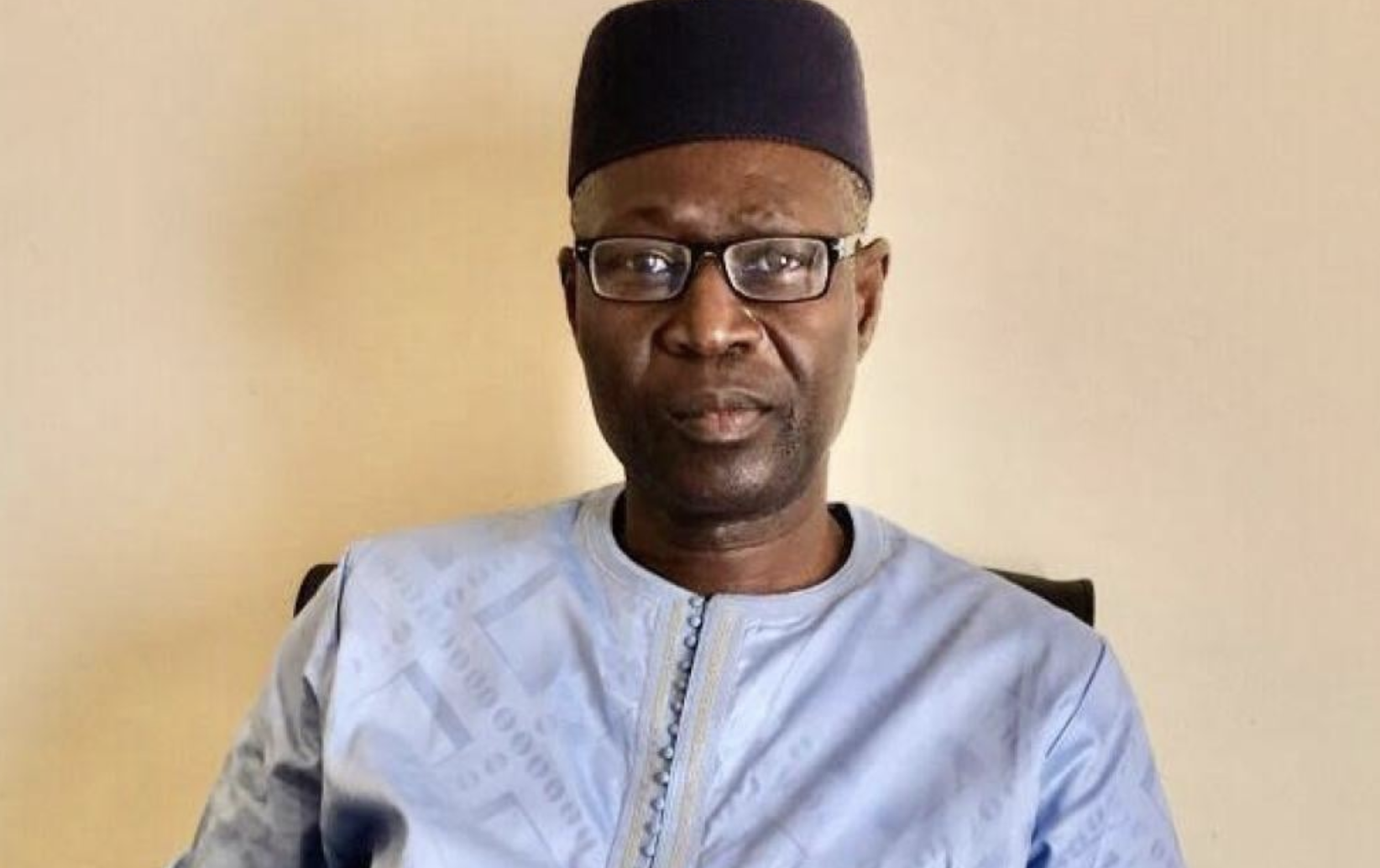 Professor Amath Ndiaye
For decades, a part of the African public opinion has been led to believe that the operations account held at the French Treasury represented a kind of money “confiscated” by France. This perception does not stand up to recent facts.
In 2023, the BEAC – central bank of the CEMAC – received 196.7 billion CFA francs in interest on its reserves placed at the French Treasury, an increase of 358% compared to 2022. These returns are directly related to the rise in the ECB’s key rates, applied according to modalities set by monetary agreements (minimum guaranteed rate of 0.75% or 1%, with the application of the marginal lending facility rate when it is higher).
In other words, the operations account functions as a remunerated savings account, and not as an inaccessible safe deposit box: it generates income for the African central bank.
The comparison with the UEMOA is enlightening: since the closure of its operations account in 2021, the BCEAO directly manages its external reserves, placing them in bank deposits, debt securities, and IMF assets, for a total return of 176.96 billion CFA francs in 2023.
These figures show that it is inaccurate to present the operations account as a deduction or a plundering: it is an investment, certainly regulated by agreements, but which generates significant income for African central banks.
Watch the video version on YouTube at: https://youtu.be/4ICAdVGtFOg
By Ikechukwu ORJI